Exploring Community Approaches to Interreligious Peace
Interreligious peace is crucial to create stable, welcoming communities where all can thrive.
Social research is a powerful tool to help communities navigate these kinds of complex societal challenges and build a better future.
The German Institute for Global and Area Studies wished to conduct a resident survey in Lomé, Togo and Freetown, Sierra Leone to explore attitudes towards interreligious and intercultural relations. As both countries are culturally diverse, this study was important in understanding how some social norms may aid in avoiding conflict.
We used a culturally sensitive approach to build an effective survey and collect quality data to truly understand community perspectives in this area. We worked with on-the-ground enumerators to collect real, timely data that spoke to the core themes of the research.
Stakeholders & Community Partners:


What We Did
We worked with local partners to carry out the survey as effectively as possible. We:
Designed a culturally sensitive, multilingual survey with complex logic that fully addressed the research needs.
Coordinated in-person enumerators to maximize the response rate while protecting both participant and enumerator safety.
Supported the study researchers so they could use this project to support further research.
Solution & Deliverables
Interweaving Multiple Languages and Complex Logic
To accurately capture awareness of different cultural backgrounds and awareness of another culture different from their own, we developed a sophisticated survey instrument to test perceptions of different cultures.
The survey was translated into French, Ewe, and Krio to ensure inclusivity. The translation process included consideration for how questions would be received and the cultural sensitivity surrounding the subject.
We randomized sections within the survey with complex logic to meet the researcher’s needs for flexibility for different categories of respondents. To ensure the survey collected high-quality data that wouldn’t be influenced by any participant’s tendency to select a certain response (e.g., a preference for the first option in a multiple choice list), re randomized question response options.
Together, our efforts ensured the survey would be reliable and accessible to a wide variety of participants. When conducting research in multiple countries, this is crucial for project success.
Ensuring Enumerator and Participant Safety and Accessibility
In-person enumeration is more direct than other forms of data collection, so we worked carefully to protect both our enumerators and the project participants. This included complying with all local legislation. The identity of participants was not shared with any member of the research team, and we made sure no identifiable information was included in the data.
We recruited, interviewed, trained and managed a team of local enumerators in Lomé and Freetown. Due to the nature of the local cultures, it was important that the survey be accessible. The survey was designed to mitigate issues with internet connectivity. Over three weeks, our team of enumerators canvased the local population in and round busy hubs in both cities.
It was also important to ensure fairness for everyone involved – all enumerators, partners, and participants were compensated for their time. Ultimately, we exceeded the project goal by collecting over 600 responses.
Research Development
We worked closely with the GiGA researchers to understand how the survey data fit into their broader research goals. As with many complex studies, the end goal was not simply to conduct the survey once, but to use this iteration as a blueprint to guide similar research, both in the same countries to expand on the initial findings, and in further countries. Over time, this will lead to rich insights on interreligious peace that are valuable not just within the African continent, but globally.

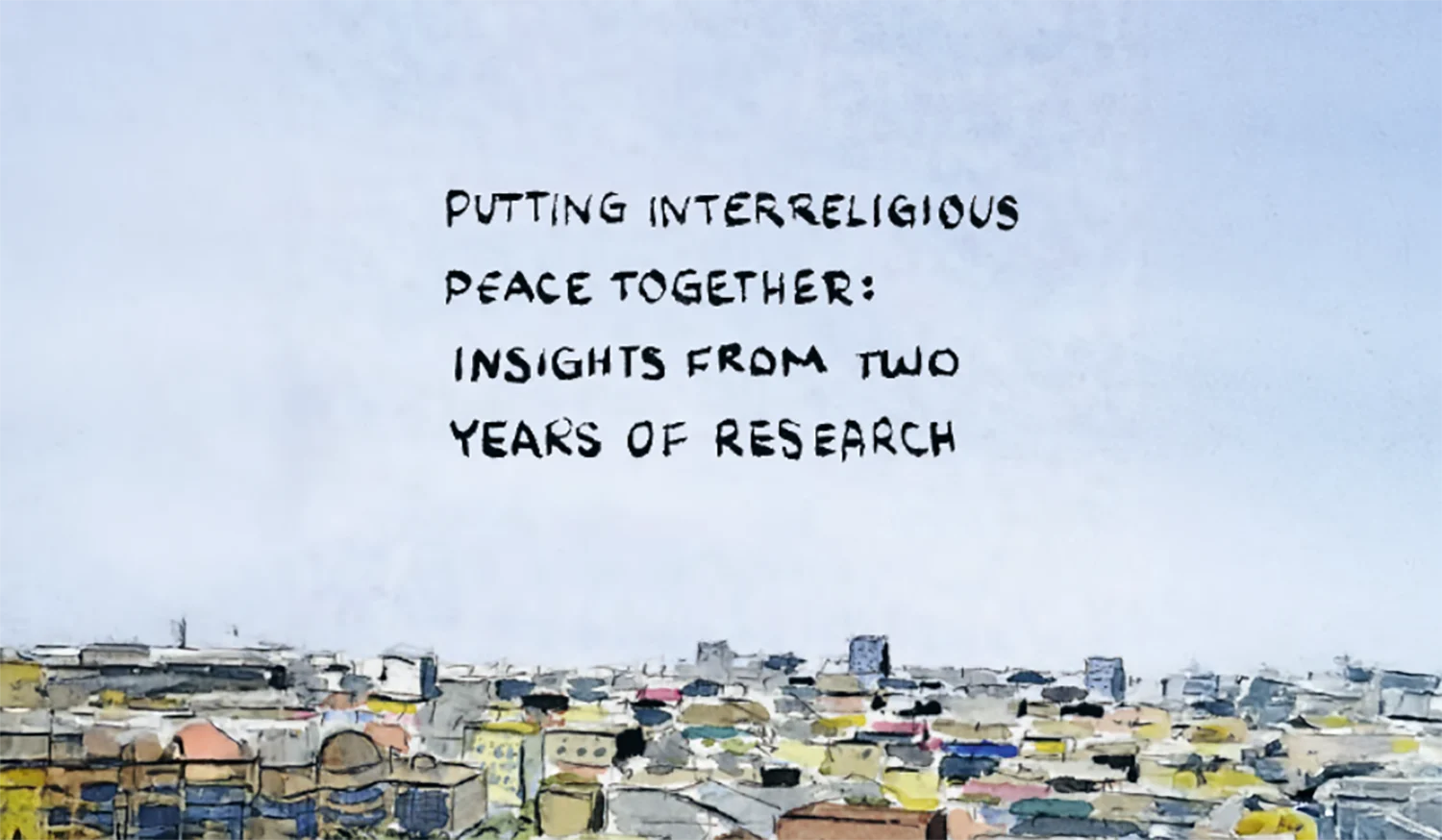
Illustrated Report Cover – Putting Interreligious Peace Together
As a result of our study, GiGA researchers created an illustrated report highlighting the key findings. This explanation of the results in plain language ensures the research is accessible, allowing it to start conversations in a variety of communities.

Illustrated Report – Map
The illustrated report includes a map showing the levels of interreligious peace around the world. Togo and Sierra Leone are shown to have high levels of interreligious peace, making them ideal locations for the study.
The map shows levels of interreligious peace around the world in 2014. Darker blue countries were more peaceful, lighter blue ones less peaceful. As we wanted to learn more about interreligious peace, we turned to two of the places globally where it works best: Sierra Leone and Togo.

Illustrated Report – Acknowledgements
The section of the illustrated report acknowledging all project partners. Studies like these are often successful because of cooperation between different groups—something we have been grateful to have the opportunity to navigate on multiple projects.
Results & Impact
The researchers used the data to support multiple academic literature and crafted an accessible summary of the research: